
Eco Friendly Printing.
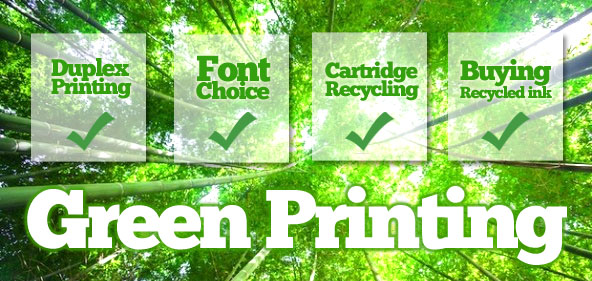
Printing is one of the main environmental impacts associated with daily office operations. However, it is also one of the easiest environmental impacts to address. By following a number of practical tips, companies can benefit from immediate environmental benefits and costs savings.
Type of Printer
Although laser printers have a lot of advantages including higher speeds and superior print quality, they use a lot of energy. Opt for an inkjet printer to lower energy use when printing.
Paper Reduction
The easiest and most effective way to cut paper usage is to use double-sided printing. This can be made the default setting on your printer for added convenience. If your printer does not support double-sided printing you have several options to fix this.
You can retrofit a printing tray that supports double-sided printing to your current device. However as some printers are too old to be retrofitted the alternative is to invest in a new one. If you do buy a new printer make sure to recycle the old one. Check if your waste collector can recycle the printer, or find a charity that would benefit from a second-hand printer. Whether you retrofit your current printer or buy a new one, the investment cost will be paid back relatively quickly from saving on paper.
Invest in 'follow-me' printing technology that requires users to confirm their printing request at the printer. Recent research suggests that 30% of printing requests are never collected at the printer by the user. 'Follow-me' printing is relatively cheap to install and is an effective way to save paper.
Behaviour Change
Behaviour change should also be addressed as a means to reduce printing volumes. Many people print whole documents instead of isolating the specific pages that they actually need. Educate staff about Print Preview so they can see the layout of a document before it reaches the printer, not after. This will allow them to select specific pages for printing and will also reduce the need to reprint due to formatting errors.
Promote the sharing and reuse of printed items amongst colleagues. Paper that only has print on one side can also be used as scrap paper for notes or for single-sided scrap printing. Make sure that recycling bins are located close to printer for convenience. Finally, try and encourage electronic rather than paper based communication.
Recycled Paper
Thought should also be given to the paper itself. Consider using recycled paper, which has a lower environmental impact. It is cheaper and usually has great quality, contrary to popular belief that recycled paper is substandard. Using recycled paper also shows a company's green initiative to clients. In addition, look out for sustainable sourced paper, identifiable by the international paper label called FSC (Forest Stewardship Council).
Ink and toner
Ink and toner are printer components that are highly hazardous. Usage of these components is reduced when cutting down on print volumes. To further reduce the impact from ink and toner it is important to make good purchasing decisions and ensure proper disposal of waste ink and toner cartridges. Make sure that the ink and toner that you are purchasing is vegetable based, as this is the environmentally friendly option. Although most of these can be recycled it is worth checking with your stationary supplier or ink and toner manufacturer on their recyclables characteristics.
Energy Consumption
Printers consume a lot of energy when running. Check if your printer has an energy saving setting, which will put the printer into sleep mode when not in use. Use a parameter to suit your company - a good benchmark for the sleep mode setting would be 15 minutes.
However, it is also important to turn off your printer overnight, on weekends and over holiday periods as the machine still consumes energy on standby mode. A good solution would be to install a timer switch to the printer plug input to automatically shut down the printer in the evenings.
It's up to office managers and employers to bring green attitudes to the workplace. By highlighting these points and demonstrating the benefits of cost savings companies can make great progress in running an energy efficient office. Businesses can save significant amounts on their energy bills and reduce the carbon dioxide they emit.
Join us at Green Planet Advertiser, and let's pave the way for a sustainable future together. Whether you're a vendor looking to expand your global reach or a consumer seeking the latest renewable energy innovations, our platform is your gateway to a greener, cleaner, and more sustainable world. Together, we'll create a brighter tomorrow powered by renewable energy.